
Seasonal Produce
The Winter Plate and Nutritional Variety
How seasonal availability shapes the daily plate and what the nutritional range of winter eating actually looks like.

The decision to begin keeping a structured food journal arrived not from any programme or external prompt, but from simple curiosity about the gap between what one intends to eat in a given week and what one actually does. Seven weeks of daily records later, the gap turned out to be more revealing than the intentions themselves.
The record used at Darwon Letters is deliberately low-friction. Each entry requires a time stamp, a rough description of what was eaten, an estimate of the portion by visual reference — small, medium, or large relative to the hand — and a single-word note on context: desk, table, standing, walking. Nothing is weighed. There are no calorie figures. The goal is observation, not accounting.
This simplicity is intentional. More elaborate systems, in this editor's experience, tend to generate anxiety rather than clarity. The moment a meal becomes a data entry problem, the act of eating shifts register — from an ordinary daily event to a performance being assessed. The food journal should sit at the edge of attention, not at its centre.
Over seven weeks, the records were reviewed each Sunday morning, usually with coffee, for about twenty minutes. The review process involved reading back through the week's entries without evaluating them — not asking whether the eating was good or poor, but simply looking for rhythm. When did the meal happen? How long after waking? What preceded it? What followed?

The record notebook. London, 2026.
The most consistent finding across the seven weeks was not what was eaten, but when. Lunch shifted in timing by as much as two hours depending on the level of scheduled activity in the morning. On days that began with a walk or any sustained outdoor movement before noon, lunch arrived earlier and the portion recorded was reliably smaller. On sedentary mornings — defined here as desk-based from waking — lunch arrived later and portions were notably larger.
This observation aligns broadly with what nutrition literature has noted about the relationship between morning movement and appetite timing, though the editorial position of Darwon Letters is not to draw causal conclusions from a personal record. What the record shows is a pattern. Whether that pattern generalises, or what drives it, belongs to a different kind of investigation than this one.
A second observation concerned the evening meal. On evenings preceded by a substantial lunch — recorded as "large" — the evening meal was consistently lighter and arrived later, sometimes as late as 21:00. On evenings following a missed or minimal lunch, the evening meal arrived earlier and the record notes frequently included the word "more" added to the portion estimate. This was not a planned adjustment; it appeared simply as how the day unfolded.
"The record does not tell you what to eat. It tells you what you actually did — which is a different and more interesting document."
Eleanor Whitfield — Darwon Letters, January 2026
Weekdays showed a reasonably consistent structure across all seven weeks. The first meal arrived between 07:30 and 09:00, lunch between 12:00 and 14:30, and an evening meal between 18:30 and 21:00. Weekends were a different landscape entirely. Breakfast on Saturdays appeared as late as 11:00 in the record, effectively collapsing breakfast and lunch into a single late-morning meal. The following meal — whatever one calls it — then arrived in mid-afternoon, and the record shows an additional small entry in the late evening in five out of seven Saturdays.
This weekend drift is not presented here as a problem to address. It is simply what the record showed. The observation is that eating rhythm is not primarily about nutritional planning — it is about schedule. When the schedule changes, the food rhythm changes with it, in ways that are largely automatic rather than deliberate. This seems worth knowing.
One practical question that emerged from the weekend records was whether the later start altered the nutritional variety of the day. In weeks where the Saturday record showed a late single-meal start, the vegetable count for that day was visibly lower than on weekdays — not because vegetables were avoided, but because fewer meals meant fewer occasions on which they naturally appeared. The rhythm of eating, it turns out, shapes the composition of eating, even when no deliberate composition decisions are being made.
The portion notation system used in this record — small, medium, large, by hand reference — proved more informative than anticipated. Over seven weeks, the hand-reference method produced a surprisingly stable vocabulary. The writer found that a "medium" portion was consistently about the same size regardless of the food type, because the hand itself is constant. What changed was the number of "mediums" consumed at a single sitting, and this number tracked closely with the time elapsed since the previous meal.
A longer gap consistently produced more portions at the next meal. This was true both in absolute terms and in the writer's own notes, which frequently recorded the observation "very hungry" on entries following a gap of more than five hours. The record did not require calorie figures to make this visible. The pattern emerged from the timing entries alone.
Morning movement before noon consistently corresponded with an earlier and smaller lunch across all seven weeks.
Weekend schedule changes produced measurable shifts in both meal timing and vegetable variety without any deliberate dietary change.
Portion size tracked closely with time elapsed since the previous meal — gaps above five hours were followed by larger portions at each occurrence.
The daily record required less than three minutes of writing — friction level appears to be the main determinant of sustained record-keeping.
A food record of this kind has obvious limits. It records what was consumed, not what the body did with it. It records portion estimates, not actual quantities. It records context in one word, not the full social and environmental texture of the meal. A birthday dinner noted as "large, table" contains neither the wine nor the dessert that likely accompanied it, unless the writer remembered to add them — and on a birthday, this seems unlikely.
These limits are not reasons to avoid record-keeping. They are reasons to read the record with appropriate circumspection. The record shows patterns. It does not explain them and it does not prescribe a response to them. What a reader — or a writer — does with the pattern belongs to a different category of decision than the record itself.
For anyone considering a similar project, the recommendation from this record would be: start with a blank notebook and a pen, set a three-minute daily limit, and commit to seven Sundays of reading back without judging. The patterns that emerge over that period are likely to be more informative about your particular daily food rhythm than any general dietary framework applied from outside.
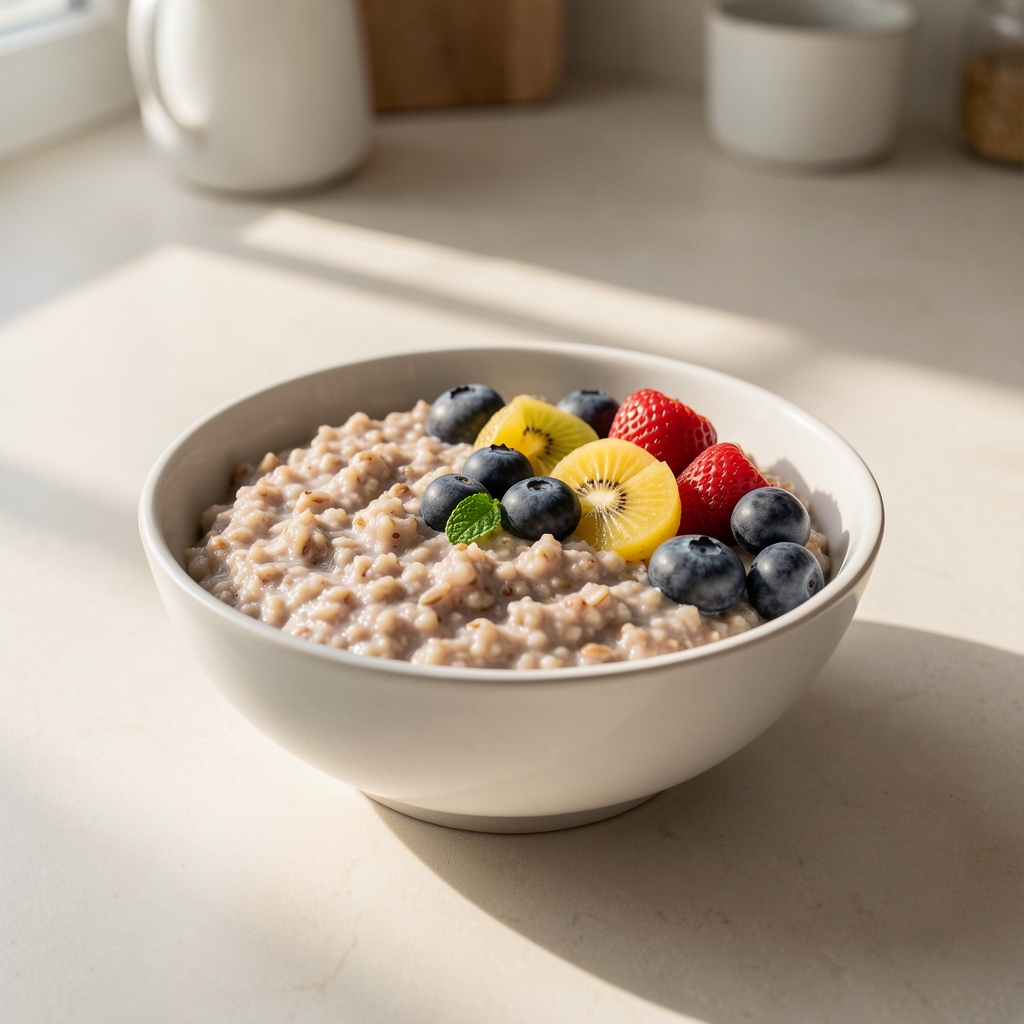
Recorded breakfast, Week 4. London, 2026.
Articles published on Darwon Letters are editorial in nature and reflect the writers' observations on everyday nutrition practices and weight awareness. The content is not intended as professional advice, nor as guidance for the management of any specific condition. Readers with specific concerns about their daily routines are encouraged to speak with a qualified wellness professional.

Eleanor Whitfield is the founding editor of Darwon Letters. Her writing focusses on the practical rhythms of everyday eating — the gap between nutritional intention and daily practice, and what the record of that gap can tell us. She has written about food, weight awareness, and the discipline of observation since 2022.
More from this author →
How seasonal availability shapes the daily plate and what the nutritional range of winter eating actually looks like.

A six-week observation of how daily movement levels correspond with portion choices at the evening meal.